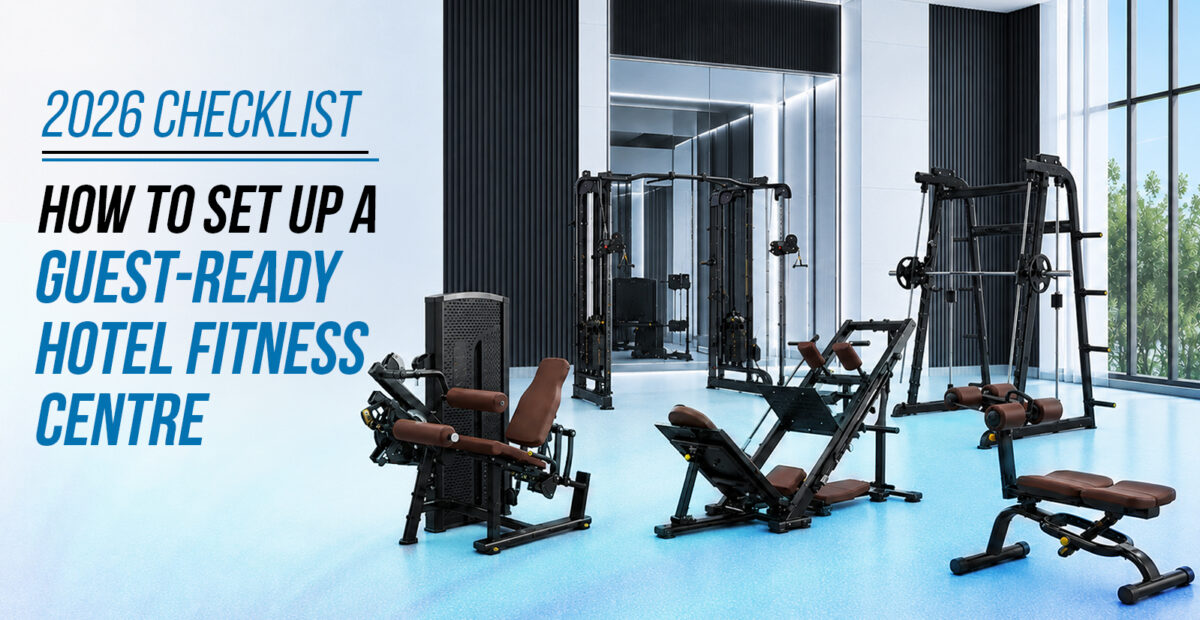
Setting Up a Hotel Fitness Centre: Equipment Checklist for Hospitality Brands
A hotel gym is perhaps the last amenity to be tended to until it is broken and shows up in the guest complaint book. Sometimes, not even then. It might get some considerable amount of attention only when it shows up in a review. For most guests, this gym is only a temporary bridge to keeping up with their fitness routine while they travel. That makes the hotel fitness centre less a fitness product and more a guest-experience touchpoint.
Getting the experience right means equipping the space with equipment that guests can use without instructions and fitting the necessary equipment within limited space. For the owner, durable equipment requiring minimum maintenance and supervision would be preferred.
Here’s a checklist to help you set one up – from guest expectations to space planning to the equipment list itself. For the wider picture across hotels, residential societies, and campuses, see our institutional gym setup guide.
What Guests Expect from a Hotel Gym
Hotel gym expectations are fairly consistent across guest types, and none of them is complicated. Guests want cardio – a treadmill is close to non-negotiable, since it’s the one machine almost every traveller already knows how to use. Beyond that, functional and free-weight options cover the guests who want a fuller workout without needing a spotter or a trainer.
What guests don’t want is a learning curve. A short-stay guest isn’t going to read an equipment manual or watch a tutorial video; if a machine isn’t self-explanatory, it typically goes unused, or worse, gets used incorrectly. That’s why hotel gym equipment should favour simple, guided movements over complex, adjustable machines built for serious training. Reliability matters just as much as functionality – a broken treadmill during a guest’s stay is close to a guaranteed complaint, and there’s usually no fitness staff around to manage the fallout in the moment.
Space Planning for Hotel Fitness Centres
Most hotel gyms are set up within the space that is left over once all other amenities and guest rooms are planned. Often, a guest room or a corner block is converted into a small gym. This means the process of equipment selection begins with understanding available space and fitting equipment into that space, and not the other way round.
Small-footprint layouts require equipment to be chosen for the actual space available for use. This should include sufficient clearance space for machines, like treadmills and functional trainers. Natural light and sightlines to the outdoors (or, at minimum, glass walls and good lighting) do a lot to make a small hotel gym feel less cramped, and this kind of aesthetic integration matters more in hospitality than almost anywhere else, since it’s part of what guests are implicitly paying for.
Equipment Checklist
A well-planned gym does not require more space. It must only be equipped with the basic equipment that guests often use.
- Treadmill(s): at least one, two for properties above roughly 100 rooms or with a business-travel-heavy guest mix. See our treadmill range.
- Elliptical or exercise bike: a lower-impact cardio option, useful for guests avoiding high-impact workouts. Browse ellipticals and exercise bikes.
- Functional trainer or compact multigym: gives guests a resistance-training option without needing multiple single-purpose machines. See our functional trainer range.
- Free weights and a bench: a basic dumbbell rack and an adjustable bench, for guests who prefer traditional strength training. Explore free-weight benches.
- Flooring: rubber flooring suited to both cardio vibration and free-weight impact, plus easy cleaning between guest use.
This checklist is only to get you started. Larger properties or high-end hospitality brands will typically have more space at their disposal, so they can add more equipment, offering greater variety.
Durability & Maintenance Considerations for High-Traffic, Low-Supervision Use
Hotel gyms may be used around the clock, while also not maintaining a consistent routine. Moreover, its usage is never supervised. That combination – high, unpredictable traffic and no one correcting misuse – is harder on equipment than a typical commercial gym’s more consistent, trainer-managed usage pattern.
Frame and component durability matters more here than feature count. Brands like Body-Solid and Steelflex are commonly chosen for hospitality settings for this reason – built for sustained, low-maintenance operation rather than for the adjustability a serious lifter might want. If your property is planning ongoing service and maintenance support alongside the initial setup, that’s worth confirming directly with our team at the quote stage, since scope varies by package and location.
While the checklist and other details can get you started, you can opt for one of our packages to help with the setup. You can also browse through our equipment collection to equip your gym.
FAQs
What should be a realistic budget for setting up a hotel gym?
The budget will depend on the type of hotel, the number of rooms on the property and the package tier. For instance, a premium hotel can allocate a higher budget so the room aesthetics align with the brand image. We recommend a consultation or custom quote – it accounts for your actual space and guest profile.
How much space must be allocated to a basic hotel gym?
For a small hotel, a gym can be set up in a converted guest-room-sized space. The right equipment must be chosen for the footprint with sufficient clearance around treadmills and functional trainers.
How many treadmills does a hotel gym actually need?
One is workable for smaller properties; two is a safer minimum once you’re above roughly 100 rooms or catering to business travellers who tend to use the gym at similar times of day.
Do we need a trainer on-site for a hotel gym?
No. Hotel gyms are typically designed so the equipment can be used without supervision – simple guided machines. Having such easy-to-use equipment is more important than having a staffed commercial gym.