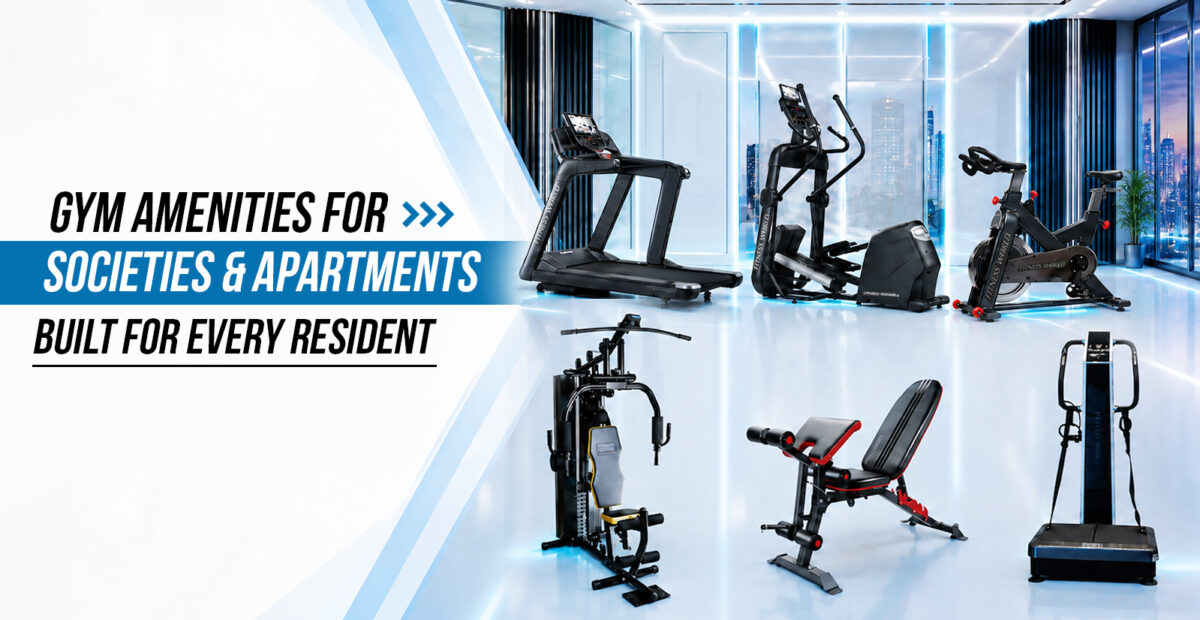
Gym Amenities for Residential Societies & Apartment Complexes: A Developer’s Equipment Guide
Amenity gyms are a part of real estate projects across India. These gyms are no longer an amenity that is added as an afterthought but rather a key differentiator. Developers club these amenities together – swimming pools, gardens, play areas, community banquet halls, and clubhouse gyms – and market them with the property. Adding it as an amenity and actually setting one up are two different things. The gym within a residential setup has to appeal to a broad, mixed-age resident base. Moreover, it has to run largely without supervision and hold up over years of shared, often careless use. Resident Welfare Associations (RWA) inherit these decisions once handover happens, which makes getting the initial setup right even more important.
This guide covers what developers and RWA committees should actually prioritise. For how residential gyms compare with hotel and campus setups, see our institutional gym setup guide.
Why Developers Are Investing in Amenity Gyms
Buyer expectations have shifted. In competitive housing markets, a clubhouse gym is now closer to table stakes than a premium add-on, and its absence can be a genuine point of comparison against a competing project. For developers, it’s also a differentiator that shows up early – in brochures and site visits, well before residents move in and start actually using it.
That shift has a practical implication: the gym gets judged on presentation and functionality from day one, often by prospective buyers who will never use it, which means equipment choice matters for sales as much as for long-term resident satisfaction.
This is also why amenity gyms increasingly show up in project marketing alongside clubhouses, swimming pools, and landscaped gardens – they photograph well, they’re easy to describe in a brochure, and they signal a certain standard of living even to buyers who won’t personally use the equipment. That makes the initial fit-out worth getting right the first time, since re-equipping a gym after residents have moved in is far more disruptive than planning it properly during construction.
Equipment That Works for a Broad Age Range
A society gym is used by people of different age groups, at times all at once – teenagers, working professionals and senior residents. Often, there is no trainer present. That’s a very different equipment brief from a commercial gym built around a target demographic.
Safety-first machine selection matters most here – guided-motion equipment with clear range-of-motion limits, weight stack shrouds, and stable frames reduce the risk of misuse when nobody’s on hand to correct form. Adjustable, feature-heavy machines aimed at serious lifters are usually the wrong choice for this setting, even if they look more impressive; simpler, sturdier equipment tends to serve a mixed-age resident base better and needs less ongoing supervision to stay safe.
Space & Budget Tiers for Residential Gyms
Space and budget for residential gyms are generally fixed at the very beginning. It thus makes sense to plan it out from the start. We have package tiers designed specifically to aid you with residential gym setups:
Core Package: a practical entry point for smaller societies or single-tower developments – a compact set covering basic cardio, a multigym, and free weights, sized for a standard clubhouse room.
Titanium Package: suited to larger developments or townships with higher resident numbers, adding capacity and a broader equipment mix across a multi-zone gym space.
Platinum Package: for large-scale or premium residential projects positioning the gym as a flagship amenity, with a wider equipment range and higher-end finish.
For hotel owners and campuses looking to set up a gym or a workout space, on site, here is a comprehensive guide to setting up a fitness centre.
Working with a Supplier from Planning to Installation
When you plan to equip a society gym, it means you need to treat it as a project – completed stage-by-stage. It begins with evaluating the space available for the gym, entailing confirmation of room dimensions, ceiling height and structural considerations for heavy equipment. This is followed up by package and equipment selection based on the number of residents and budget. The final stage is the installation and setup.
Our Gym Set-up Services cover this process end to end, from initial planning through to installation, which is particularly useful for developers coordinating gym setup alongside other clubhouse amenities on a construction timeline. Getting a supplier involved early, before the room is finalised, generally leads to a better equipment fit than retrofitting equipment into a space that’s already built. It also gives RWA committees a clear point of contact for future upgrades or replacements, rather than having to source equipment piecemeal once the original supplier relationship has lapsed.
FAQs
What size clubhouse gym suits a 200-unit society versus a 500-unit society?
Larger developments generally need more cardio units and broader multi-gym capacity to avoid peak-hour bottlenecks; our Titanium or Platinum packages are typically a better fit than Core once you’re above roughly 300–400 units. A custom quote is the most reliable way to size this to your resident count.
Is flooring included with the equipment package?
Flooring is offered separately through our gym flooring services and can be planned and installed alongside your equipment order.
What equipment is safest for a gym used by residents of all ages without supervision?
Guided-motion machines with weight stack shrouds and simple movement patterns are generally the safer choice over adjustable, high-load equipment designed for serious training.
When should we bring in an equipment supplier during the construction timeline?
As early as possible – ideally while the clubhouse layout is still being finalised, so the room can be planned around the equipment rather than the other way round.
Which package is right for a mid-size residential society?
Most mid-size societies start well with the Core Package and can add equipment as resident numbers grow; larger or premium developments tend to suit Titanium or Platinum.