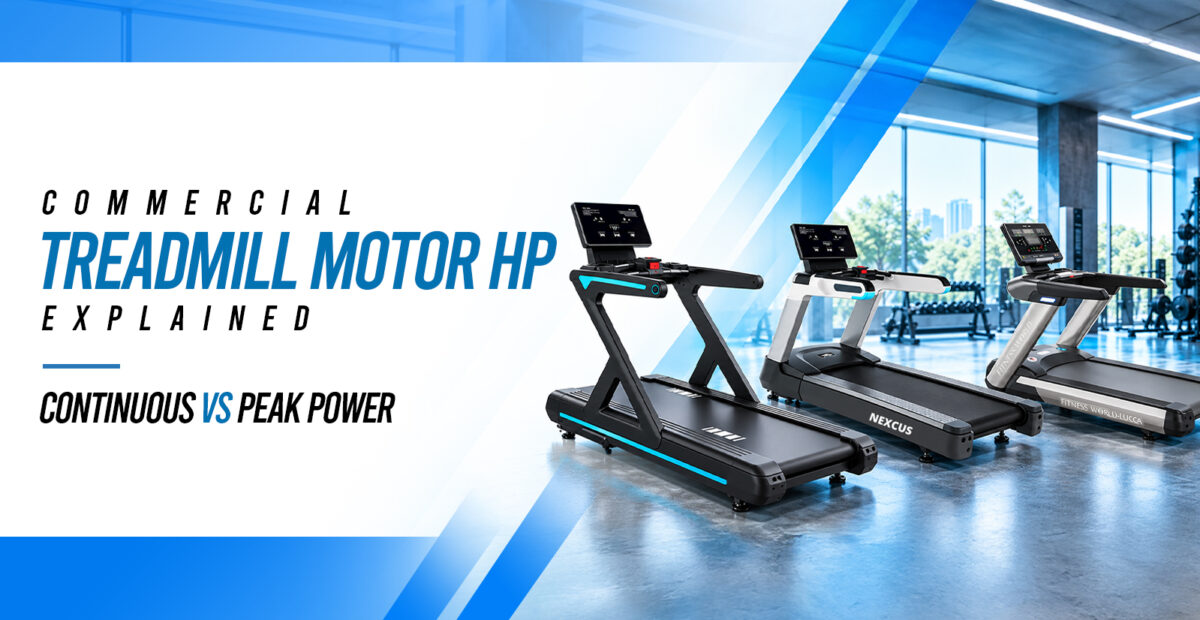
Commercial Treadmill Motor HP Explained: Continuous vs Peak Power for Gym Owners
Buying treadmills for a commercial gym is a big decision for any commercial gym operator. Get it wrong, and your maintenance budget suffers. Repairs pile up, and spare parts eat your profits.
While it’s easy to focus on the research, what most gym owners get wrong is that they chase the biggest motor number. Most of them do this because a higher motor HP feels reassuring on paper. But in reality, it is not. Imagine investing in a treadmill with a glossy 4.0 HP peak-duty motor. While it looks impressive on paper, that headline number often hides a weak continuous-duty capacity (CHP).
This guide explains commercial treadmill motor specifications. It helps you learn to compare continuous HP vs peak HP treadmill claims. You will also learn to choose a heavy-duty treadmill for high footfall gym use. This applies to commercial gym machines and other commercial fitness equipment.
A Big Motor HP Number on Paper Does Not Mean Real Power
We’ve already spoken about how a bigger motor HP on paper does not live up to its performance in reality. To understand this better, let’s take an example. Take a listing that says “4.0 HP peak / 2.5 HP CHP.” Size for 2.5 CHP, not 4.0. Peak HP measures only a few seconds of burst power, so it says nothing about long-term endurance. So when you buy motorized treadmill equipment, ignore peak HP because it will mislead you.
Instead, look at CHP, which means Continuous Duty Horsepower. It reflects the power the motor holds for hours. This is what you need to look for in commercial treadmills for gyms and clubs.
Your treadmill exercise machine is only as good as its motor. So that is why motors with CHP matter most for commercial gym machines and commercial motorized treadmills running long hours. So, how do you verify CHP before you buy?
First, ask for the written spec sheet and skip relying on motor HP figures in brochures. Then look for the CHP number on that sheet. After that, compare it to your gym’s daily usage hours. For example, the Nexcus Commercial Motorized Treadmill lists 4.0 HP AC continuous and 8.0 HP peak. Use the 4.0 figure, not the 8.0 headline.
Price tags are another trap that buyers often fall for.
A cheaper treadmill with a big peak-HP label might look like a bargain. But it’s not. Cheap bargains come with extended costs. The price increases once you add accessories like belts, decks, rollers, and control boards. Labour and downtime add to the cost. So before you buy, compare total cost and not just sticker price.
Keep this guide to maintaining your treadmill handy. It helps you to prepare for routine maintenance and avoid emergency repairs.
Now that you understand why CHP should be considered for commercial treadmills, the next step is determining which motor type delivers the best performance for your unit. This brings us to the AC vs. DC treadmill motor debate for gym use.
AC or DC? Pick the Motor That Keeps Your Treadmills Running Smoothly
AC motor vs DC motor treadmill for gym use
Choosing the right motor type is important because you do not want to end up with a treadmill that breaks down due to its inability to bear the running loads. Here’s what you need to know when choosing the right motor.
Many residential and light-commercial models rely on DC motors. These motors are ideal for smaller gyms with less footfall and gyms in smaller housing societies. They cannot be used in high footfall areas like commercial gyms and clubhouses that have a lot of treadmill use. For these spaces, you need high-end commercial treadmills that use AC motors.
They might require a higher upfront investment, but their build and performance are capable of handling the daily footfalls of commercial gyms.
When auditing commercial treadmill motor specifications, you need to choose the latter because that’s what works well for your space.
If you are also considering investing in treadmill belt types, see our guide to Curved vs Motorized Commercial Treadmills for a better understanding.
How Much HP Treadmill Is Needed for a Commercial Gym?
Now the big question is how much HP treadmill is needed for a commercial gym. There is no right or wrong answer. Start by watching your foot traffic because that number drives everything.
Suppose you are buying treadmills for a housing society gym or clubhouse. These spaces see 3 to 6 hours of daily use. In that case, tell your vendor you need a 3.0 to 3.5 CHP motor. Ask for a machine built for steady daily rotation. This setup will handle your members without strain.
Alternatively, if your gym runs 6 to 10 hours daily, ask for at least a 3.5 CHP AC motor. For high-footfall commercial gyms running 10+ hours daily, specify a 3.5 to 5.0+ CHP AC motor. A model like the Q-10 Commercial Motorized Treadmill with a 10 HP AC motor is worth comparing. Once the motor is right, confirm the machine is built for heavy daily use. These commercial treadmill motor specifications keep the motor cool. They also prevent breakdowns and keep your maintenance costs low.
Conclusion
Procurement managers should keep a short checklist before buying. First, get the CHP rating in writing and then confirm the motor type. Ask about the warranty terms and local spare availability. Also ask about service response time. Use this checklist before buying a commercial treadmill alongside those vendor questions. This checklist helps when you buy motorized treadmill options online in India. Use it for motorized treadmill online in India for commercial use searches.
Match the HP to your real traffic; that way, your commercial treadmills work as hard as your members do. And you skip the service calls. For a broader buying framework, keep this blog on 8 Factors to Consider While Purchasing a Treadmill handy. It is an ideal read before you finalize your next commercial treadmill purchase.
FAQs
1. My treadmill listing says “4.0 HP peak” and “2.5 HP CHP.” Which number should I use for a commercial gym?
You should use the CHP figure for your decision. Peak HP only covers a few seconds of burst power. CHP, on the other hand, shows what the motor sustains over hours. When a listing shows “4.0 HP peak / 2.5 HP CHP,” size the machine for 2.5. Then ask the vendor for the continuous rating in writing. The Nexcus Commercial Motorized Treadmill, for instance, lists 4.0 HP AC continuous / 8.0 HP peak. That continuous figure tells you whether it will last.
2. Will a treadmill with a high peak HP number survive 10+ hours of daily use in a high-footfall gym?
Not necessarily, because peak HP says little about heat management or duty cycle. For 10+ hours of daily use, specify a 3.5 to 5.0+ CHP AC motor with a VFD inverter. Then add 3.0 to 3.5-inch steel rollers and a pre-waxed deck. The Q-10 Commercial Motorized Treadmill, for example, has a 10 HP AC motor worth comparing. But confirm the continuous rating in writing before you buy.
3. Why is the cheapest treadmill with the biggest HP number a risky buy for my gym?
It combines peak HP marketing with price-only buying. As a result, it hides real costs in belts, decks, rollers, and downtime. Lower-rated DC motors also overheat under heavy use. Brushed motors need replacements too. So compare AC vs DC motors for treadmill use before deciding. Then look at total cost of ownership, not sticker price alone. A failed motor means members see an out-of-order sign during peak hours. That damages trust and hurts member retention.
4. How can I verify continuous HP and duty rating before I buy a motorized treadmill online in India for commercial use?
Request a written spec sheet, not the brochure or online listing. It should show the CHP rating, duty cycle, motor type, VFD rating, and warranty terms. This matters most for a motorized treadmill online in India for commercial use search. Listings tend to emphasize peak HP and hide CHP. So written proof is essential. Use this checklist before buying a commercial treadmill to guide your vendor questions. If the seller cannot provide the continuous rating in writing, treat the headline HP as marketing.