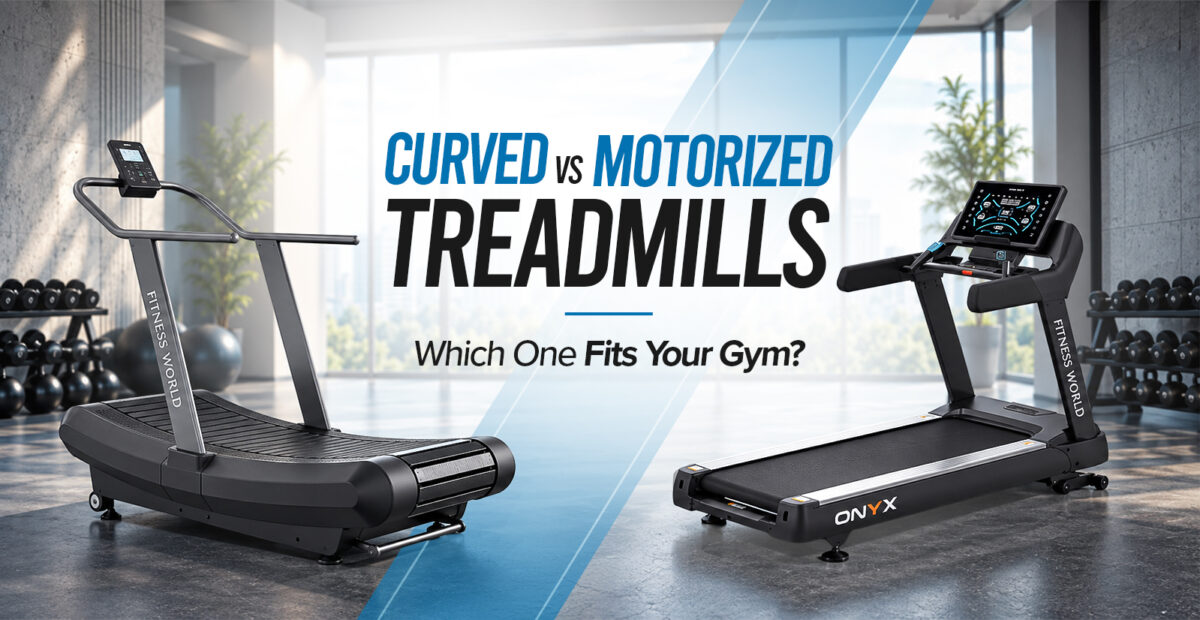
Curved vs. Motorized Commercial Treadmills: Which One Fits Your Gym’s Training Zones?
Most commercial gyms default to motorized treadmills without asking a simple question: is this machine even the right format for the zone it’s going into? A treadmill built for a steady-state cardio row and a treadmill built for a HIIT circuit or a sprint-conditioning corner don’t need to be the same machine. That’s where curved, non-motorized treadmills come into the conversation.
Fitness World’s commercial range includes both formats, AC motorized treadmills such as the Nexcus and Q-10, and the non-motorized Commercial Curved treadmill. Understanding what separates them helps gym owners avoid a mismatch between equipment and how it will actually be used.
What Actually Separates a Curved Treadmill from a Motorized One?
The difference isn’t cosmetic. It changes how the machine runs, who it suits, and what it costs to operate.
A motorized treadmill uses an AC motor to drive the belt at a speed the user selects, or that a program sets. The user’s job is to keep pace with the belt. Fitness World’s Q-10, for example, runs on a 10 HP AC industrial-grade motor with a 22 x 60 inch running surface, precise incline control from 0–20%, a -3% declineable deck, and a reverse walking feature, built for structured, program-driven cardio sessions.
A curved, non-motorized treadmill works the opposite way. There’s no motor and no fixed belt speed. On Fitness World’s Commercial Curved model, the belt only moves because the user drives it, longer strides up the curved deck increase speed, and stepping back slows it down naturally. It requires zero electricity, runs on a 176 x 49 cm effective running surface, and has an unlimited speed range because there’s no motor governing the top end.
| Factor | Motorized (e.g. Q-10) | Curved Non-Motorized (Commercial Curved) |
| Power source | 10 HP AC industrial-grade motor | None, zero electricity required |
| Speed control | Belt-driven, user matches pace | Self-paced by stride length |
| Speed range | 1.0 – 20.0 km/h (Nexcus example) | Unlimited, user-driven |
| Incline | 0 – 20%, -3% decline available | Fixed curved deck profile |
| Max user weight | 200 kg | 200 kg |
| Best suited for | Structured cardio, incline training, steady-state runs | Sprint intervals, HIIT circuits, functional training |
Where Each Format Makes Commercial Sense
Motorized treadmills remain the right default for general cardio zones, the space where members walk, jog, or run at a fixed pace for 20 – 45 minutes, follow incline programs, or use heart-rate-based training. Their programmable speed and incline control, along with features like the Q-10’s reverse walking or the Nexcus’s dot-matrix display showing time, speed, incline, and heart rate, support this kind of structured use well.
Curved treadmills fit differently. Because the user controls speed entirely through effort, they’re better suited to:
- Sprint intervals and conditioning circuits
- CrossFit-style or functional training zones where treadmills sit alongside strength stations
- HIIT class formats with short, high-intensity bursts
- Facilities looking to reduce electricity dependence for one or more cardio stations
If your gym is building out a functional training area alongside equipment from the Cross Fit or Gym Station categories, a curved treadmill can sit naturally in that mix rather than in a standard cardio row.
Practical Considerations Before You Choose
A few questions help clarify the decision for your specific floor:
- What’s the training format? Steady-state and program-based cardio favors a motorized machine. Interval-based, self-paced training favors curved.
- Does the zone have reliable power access? A curved treadmill sidesteps this entirely since it needs no electricity.
- What’s the member profile? Beginners and general members often prefer the predictability of a motor-driven belt; experienced athletes tend to adapt quickly to a curved deck.
- How does it fit your equipment mix? Most commercial floors benefit from having both formats rather than choosing one exclusively – a motorized bank for general cardio, and one or two curved units for a functional or HIIT zone.
Space and layout matter too. Since curved treadmills don’t need a power point nearby, they offer more flexibility for placement within a functional training zone, while motorized treadmills are typically grouped together near existing power infrastructure.
The Bottom Line
Neither format replaces the other, they serve different parts of a commercial gym. Motorized treadmills, like Fitness World’s Nexcus and Q-10, are built for structured, program-driven cardio. Curved, non-motorized treadmills, like the Commercial Curved, are built for self-paced, high-intensity training. The right choice depends on what happens in that specific zone of your gym, not on picking a single “better” treadmill for the whole facility.
If you’re planning a new cardio or functional training zone, browsing Fitness World’s full commercial treadmill range is a good starting point for comparing motorized and curved options side by side.
FAQs
Is a curved treadmill better than a motorized treadmill for a commercial gym?
Neither is universally better, they suit different training styles. Curved, non-motorized treadmills work well for sprint intervals, HIIT, and functional training zones because the user controls speed through stride length. Motorized treadmills suit structured, program-based cardio with fixed speed and incline settings. Most commercial gyms benefit from having both formats rather than replacing one with the other entirely.
Do curved treadmills need electricity?
No. Curved treadmills are non-motorized and require zero electricity to operate. The belt moves purely from the user’s stride and body weight on the curved deck, which also means placement isn’t limited by proximity to a power outlet, unlike AC motorized treadmills.
What’s the maximum user weight on Fitness World’s commercial treadmills?
The Commercial Curved and Q-10 Commercial Motorized Treadmill both list a maximum user weight of 200 kg. Always check the specifications on the individual product page, since capacity and running surface dimensions can vary between models in the commercial treadmill range.
Can curved treadmills be used for regular cardio sessions, or only HIIT?
Curved treadmills can be used for general cardio, but they’re most effective for interval-based or high-intensity training since the user directly drives belt speed through effort. Members doing steady, paced walking or running sessions often find a motorized treadmill’s fixed-speed belt more predictable and comfortable for longer, structured sessions>