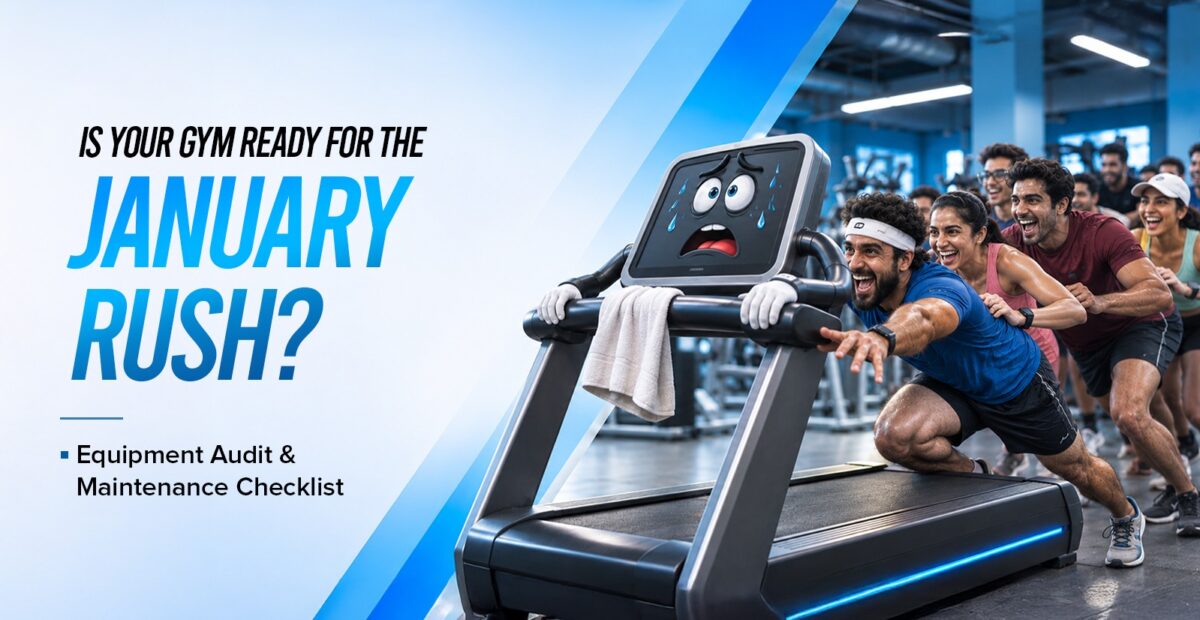
Is Your Gym Ready for the January Rush? A Pre-New-Year Equipment Audit & Maintenance Checklist for Gym Owners in India
January is the time each year when gym owners see a spurt in new registrations. We know what happens behind the scenes. Post-festive guilt kicks in, New Year resolutions are made, and winter cold or bad air quality drives runners and beginners off the streets and into your gym. Enquiries, trial visits and sign-ups hit the roof.
All the activity rings in a new year cheer as you work. However, here’s the uncomfortable part: all that increased, heavy usage grinds down the high-friction parts when you need them the most. It gets worse if you haven’t invested in the maintenance of your commercial gym equipment. And we are all aware. Nothing kills a new member’s motivation faster than an “Out of Order” sign during the 7 AM rush. It also hurts renewals, and soon you start seeing the numbers dwindle. The fix: plan and complete your equipment maintenance in November, so you have sufficient time to fix things.
The question is: where to begin? We would suggest you begin by understanding how your gym functions and how your members navigate your space.
Audit Your Floor Mix and Find the Bottlenecks
One typical thing we notice on Indian commercial gym floors is a rise in footfall during two periods: early mornings before work and evenings after office hours.
Another noticeable point is how modern commercial gym plans recommend a different cardio-to-strength split from the traditional 50:50. Strength and functional training is gaining popularity among the youth and women in India. Nevertheless, treadmills continue to be the all-time favourite and go-to equipment for those January beginners.
Don’t take the statements we made here at face value. Spend some time on your gym floor this November, especially during peak hours, to watch which areas are crowded, what the younger members and women are focusing on and how much time they spend on the various equipment. It’s usually treadmills, cable crossovers, squat racks and adjustable benches.
So does buying a pile of permanent treadmills help you manage that January spike in registrations? We wouldn’t call it the best, most cost-effective way to deal with a six-week spike. Yes, six weeks, because most gym owners watch those numbers dwindle slowly until mid-February and from April to November, you will watch those machines sit idle. What you can do instead is add compact, high-turnover capacity, such as some adjustable benches or functional accessories. This will help you manage that additional crowd that comes in.
Pre-January Cardio Equipment Checklist
Nevertheless, your cardio machines are bound to take the worst beating in January. Use this gym equipment maintenance checklist to separate what your staff can handle daily from what needs a qualified technician:
Daily & Weekly Staff Checks
Treadmill belts and decks
● Check running belt alignment and ensure it remains centred
● Check both edges for any edge fraying, tears or any visible deterioration
● Check the underside of the running belt and deck for signs of insufficient lubrication, where applicable.
● Lubricate non-waxed decks strictly at the manufacturer’s recommended intervals using OEM-approved 100% silicone.
● Do not use a silicone spray unless the manufacturer’s instructions specifically state that the formulation is acceptable.
Emergency stops and consoles
● Test treadmill emergency stop safety keys daily
● Verify that essential controls such as Start, Stop, Speed and Incline work as intended.
● Ensure that the display registers the selections and settings accurately
● Look for unresponsive buttons, intermittent operation or display errors.
Elliptical rails
● Wipe elliptical glide rails and tracks daily using a clean, lint-free cloth to remove dust, dirt and debris.
● Keep roller contact surfaces clean to prevent premature wear, uneven movement and potential damage to the rollers and rails.
● Clean and inspect rollers according to the manufacturer’s recommended maintenance schedule.
Bike pedals and cranks
● Inspect pedal straps for looseness, fraying or damage. Ensure they are securely fastened and replace if worn.
● Inspect pedals and crank arms for looseness, excessive movement or signs of wear.
● Check crank arm and pedal bolt tightness weekly on upright, recumbent and spin bikes.
● Tighten loose bolts only as required, following the manufacturer’s specified torque settings.
Resistance levels
● Test magnetic or friction resistance across every level on bikes and cross trainers.
● Check whether the resistance changes smoothly at each setting adjustment
● Check for any weird noises, slipping or sticking
Pre-January Technician Checks
Treadmill motors and hoods
Vacuum dust and debris from motor hoods. Note: Removing the motor hood should be performed by trained maintenance personnel, following the manufacturer’s safety instructions. Gym floor staff should not open electrical compartments unless authorised and trained.
Check drive-belt tension (By drive belt, we mean the motor drive belt, and not the running belt)
Test motor performance under load. What to look for? Check for consistent speed, overheating of the motor, any unusual noises, any jerks or excessive vibration.
Power and stabiliser setup
● Check whether the supply voltage and frequency for all your imported cardio equipment is as per manufacturer recommendations.
● Bring in a qualified electrician to ensure proper and effective earthing for all equipment.
● Ensure that voltage stabilisers are installed (as per manufacturer recommendations), and appropriately rated servo stabilisers are used where needed. Ensure that these stabilisers maintain the required output voltage under normal operating conditions.
● Inspect power cables, plugs, sockets and stabiliser connections for damage, overheating or loose connections.
Strength and Free-Weight Inspection Checklist
Go through every strength station before the crowds arrive. If something looks unsafe, flag it immediately and keep it off the floor until a qualified technician fixes it. Nobody should have to deal with a frayed cable or risk it with an unsafe machine.
Selectorised Machines
● Steel cables: Check coated cables for kinks, flattening, or exposed wire strands. Any cable showing broken strands, significant kinking, deformation or other safety-critical damage should be taken out of service and replaced. Do not attempt to repair damaged lifting cables.
● Pulleys, rods, and pins: Spin pulleys to feel for smooth bearings, wipe chrome guide rods, and replace bent selector pins.
Plate-Loaded Equipment and Racks
● Pivot bearings and bolts: Lubricate pivot bearings at the manufacturer’s recommended intervals and torque all frame bolts.
● Welds and safety hardware: Inspect structural welds, safety catches, and J-hooks for cracks.
Benches and Free Weights
● Benches and upholstery: Check incline bench adjustment ladder teeth for wear and re-upholster ripped pads. Note: Re-upholstering a ripped pad is appropriate, but if the underlying padding, support structure or bench frame is damaged, those components must also be repaired or replaced.
● Dumbbells and barbells: Pull dumbbells with loose heads and bent barbells off the floor right away.
Preventive Maintenance vs. Breakdown Repair
If you’d rather wait for the machine to die in January than pay for the spare parts now, then you must also be prepared to shell out some extra money for delayed deliveries, emergency technician call-outs and membership non-renewals. Commercial gym equipment maintenance done on a schedule extends equipment life and protects your peak capacity.
The best way is to build a calendar:
● Daily Maintenance: Staff wipe-downs and visual checks.
● Monthly Maintenance: Servicing for high-volume machines.
● Quarterly Maintenance: Technician inspections, with one timed for November or early December.
Annual servicing is not sufficient for a commercial gym which is sweating it out daily. If your machines are over 3 years old, if you run 25 or more machines and have no in-house technician to handle the regular maintenance, an Annual Maintenance Contract will help you manage your gym maintenance with clear response-time guarantees.
It’s cheaper than prolonged downtime.
When to Repair, Replace, or Add Equipment
Sometimes, repairs are not sufficient. You may have to replace the equipment instead of incurring another repair bill. Opt for a gym equipment replacement when a single repair costs 35% to 45% of a new unit, when there are recurring breakdowns or when the spare parts are hard to find. Calculate your losses during downtime and the energy draw, and you will see the real cost of ownership. For a more in-depth guide on when to repair and replace, read our guide on retrofitting.
If you’re upgrading or expanding, remember that Indian procurement takes time. The following are indicative delivery and installation timelines:
● In-stock equipment: one to two weeks for delivery and installation.
● Bulk or custom orders: three to five weeks.
● Special-order imported machines: six to ten weeks or more.
Talk early with a gym equipment supplier in India, so you have time to arrange business loans, NBFC equipment finance or EMI options before January 1.
Floor and Facility Safety Checks
Finish your audit by looking at everything around the equipment:
● Gym Flooring: Re-glue lifted rubber tile edges, upgrade free-weight drop zones (consider 25–40 mm high-density shock-absorbing mats), and keep entrance walkways slip-free.
● Mirrors and Ventilation: Replace cracked mirrors immediately and check safety backing films. Service your HVAC systems and air filters in December, so air keeps moving during winter sessions. Clean filters alone do not guarantee ventilation. Check for fresh-air intake, exhaust systems and airflow and ventilation in crowded workout spaces.
● Emergency Readiness: Keep emergency exits, staircases and evacuation routes clear at all times. Inspect fire extinguishers regularly and arrange servicing, testing and refilling through competent professionals in accordance with applicable IS 2190 requirements, manufacturer instructions and local fire-safety regulations. Restock first-aid kits, check expiry dates and ensure that emergency electrical isolation switches are clearly labelled and accessible to authorised personnel.
If you are planning to replace your gym floor, read up on these 4 things you should know before buying a commercial gym floor.
The Bottom Line
Do this audit in November, and your facility goes into January safe, compliant and ready for the crowd. Skip it, and you’ll be explaining to a queue of frustrated newcomers why the treadmill is dead.
Planning to add or replace machines? Talk to our team or visit the Noida showroom.
FAQs
How do you decide between repairing and replacing gym equipment before January?
Consider replacing a machine when a single repair costs 35% to 45% of a new unit, breakdowns recur frequently, or spare parts are difficult to find. Weighing revenue lost during equipment downtime alongside higher energy draw reveals the true cost of ownership before you pay for another repair.
How early should you order commercial gym equipment in India for a January launch?
Indicative delivery and installation timelines in India are one to two weeks for in-stock equipment, three to five weeks for bulk or custom orders, and six to ten weeks or more for special-order imported machines. Reaching out early to a gym equipment supplier in India also gives you time to arrange business loans, NBFC equipment finance, or EMI options before January 1.
When should Indian gym owners conduct a pre-New-Year equipment audit?
Gym owners should plan and complete their equipment audit and maintenance in November. Starting in November gives you enough time to source spare parts, complete technician repairs, or order replacement machines before enquiries and trial visits peak in January.
What facility and safety checks should be included in a pre-New-Year gym audit?
Alongside machines, inspect rubber flooring edges, free-weight drop zones (such as 25–40 mm shock-absorbing mats), mirror safety backing films, and HVAC fresh-air ventilation ahead of crowded winter sessions. You should also keep emergency exits clear, restock first-aid kits, ensure electrical isolation switches are clearly labelled, and service fire extinguishers in accordance with local fire-safety norms.